If you’ve ever stood in a precision machining shop, watching a vertical machining center (VMC) carve out aerospace turbine blades, medical implant parts, or mold components with sub-millimeter tolerances, you know consistency isn’t just a nice-to-have—it’s the backbone of every successful job. For vendors of XY linear way VMCs, one of the most common questions we get from shops, jobbers, and OEMs alike is: What is the repeatability of this machine? It’s not a trivial question, either. A repeatable machine can run 100 identical parts and deliver 100 parts that fit together perfectly, no additional tweaking, no rejected work, no lost time. A non-repeatable one? It’ll leave you sorting through mismatched components, scrambling to compensate for axis drift, and eating into profits before you even finish a run. XY Linear Way Vertical Machining Center
First, let’s cut through the jargon: when we talk about machine repeatability, we’re referring to how consistently a linear axis (in this case, X and Y, the two horizontal axes that move the table or the spindle, depending on your VMC’s configuration) returns to the exact same position, over and over, when given the same command. It’s different from accuracy, which is how close the machine’s commanded position is to the true, geometric “perfect” position. Repeatability is about reliability—if I tell my VMC to move the X axis to 100mm, then move it away, then come back, how often will it land right at 100mm? That number, measured in thousandths or ten-thousandths of a millimeter, is what keeps shops running smoothly.
As a supplier of XY linear way VMCs, I’ll be the first to say there’s no one-size-fits-all number for repeatability. It depends on a handful of core design choices, each of which we engineer into our machines specifically to deliver consistent, shop-proven results. Let’s break down what drives that number, how we test it, and what you can actually expect when you’re shopping for a VMC for your shop.
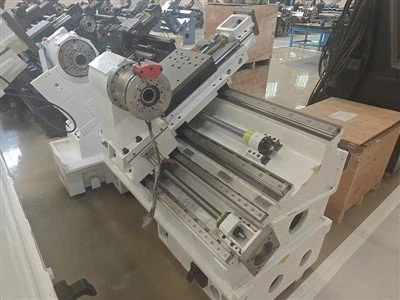
First, the linear way itself. Contrary to what some might think, linear ways (also called linear guideways, as opposed to the older box way style) are made for consistent, low-friction movement—and that directly boosts repeatability. At their core, linear ways are two parallel rails, mounted to the machine frame, with carriages that house precision ball bearings rolling along the rail’s surface. Every time that carriage moves, the bearings roll in a synchronized pattern, so there’s almost no sticking, no backlash, no variation in how the axis moves from one pass to the next. That’s a huge win for repeatability. When you combine that with our frame design—rigid, stress-relieved cast iron, precision-machined to eliminate any warping over time—you’re already starting with a foundation that holds position. Backlash, the tiny gap between mating parts that can cause an axis to “slip” when reversing direction? We engineer our linear ways to almost eliminate that, and what little remains is compensated for in our CNC control, so it doesn’t eat into your repeatability.
Next, the drive system. The most common drive for XY axes on modern VMCs is precision ball screws, and not all ball screws are created equal. We use preloaded, ground ball screws for our machines, not rolled ball screws, because ground ball screws have tighter tolerance control. Preloading means we eliminate any play in the screw and nut assembly before it’s ever installed, so every turn of the screw translates directly to linear movement on the axis—no wasted motion, no variation. The pitch of the screw also matters: a finer pitch (meaning more threads per millimeter of travel) gives more precise position control, and paired with a high-resolution encoder—one that tracks the axis position up to 10 million counts per revolution, for example—we can deliver consistent position feedback that’s accurate to less than a tenth of a thousandth of a millimeter.
Now, how do we measure repeatability, exactly? It’s not just guessing or running a few test parts. There are industry standard tests, per ISO 230-2, the international standard for testing machine tool positioning accuracy and repeatability. For X and Y axes, we run a series of moves: for example, we command the axis to move from a start position to 50 different target positions along a 500mm X-axis travel, then we have a high-precision laser interferometer (the same tool most quality labs use) measure where the axis actually lands each time. We do this multiple times, moving away from the target, moving toward it, even reversing direction, to account for any hysteresis or play. The final repeatability number isn’t an average—it’s the maximum distance between two identical positions across all those tests, at a 95% confidence interval. For our standard XY linear way VMCs, that number comes in at ±0.002mm (±2 microns) per axis over a 1-meter travel. For our high-precision model, built for aerospace and medical work, we tighten that even further to ±0.001mm (±1 micron) per axis. That’s not a marketing number—those are third-party verified test results we share with every customer before delivery.
Wait, but why would your VMC’s actual repeatability be different than that number you see online? There are a lot of variables that come into play once the machine is in your shop, and we spend a lot of time training our customers on how to maintain that repeatability over time. First, environment. If your shop has extreme temperature swings—like a garage or a warehouse where it’s 50°F in the morning and 90°F by noon—your machine’s frame, rails, and screws will expand or contract, which will throw off position. We build our machines with thermal compensation sensors, which track axis and ambient temperature in real time and adjust position commands automatically, but that works best if the shop is kept relatively stable. Second, load. If you’re running heavy parts that put 1,000kg of pressure on the table, that can flex the frame or the linear ways slightly. Our machines are engineered with load capacities well above most shop’s needs, but if you’re pushing a machine far beyond its rated load, that will impact repeatability over time. Third, maintenance. Linear ways need regular lubrication, especially high-speed high-volume machining. If you skip lubrication, the bearings in the carriage will wear unevenly, leading to drift and lower repeatability. We provide every customer with a 12-month maintenance schedule, and our service team is on call to help with any adjustments if a machine ever seems off.
I want to be transparent here, because I know how easy it is for vendors to inflate numbers to make a sale. I’ve been in this industry for 12 years, starting as a machinist, then a service technician, then moving into sales as a supplier for XY linear way VMCs—and I’ve seen the damage that overstated repeatability numbers can do. A customer buys a machine advertised with ±0.001mm repeatability, runs a job for medical implants that need to be identical, and ends up with 20% scrap because the actual in-shop repeatability is half that number. That’s not a failure of the machine—that’s a failure of the supplier to be honest about what’s achievable. Our ±0.002mm standard repeatability is for machines installed in a properly conditioned shop, following our maintenance schedule, running parts at or below the machine’s rated load. If you have a shop that needs higher precision, we can upgrade the linear ways and encoders to deliver that ±0.001mm number, no fine print.
Let’s put that number in context, so you can see what it actually means for your work. If you’re machining a small medical pin that needs to fit into a bone screw, the tolerance is often ±0.005mm. A machine with ±0.002mm repeatability will hit that mark every single time, even for 1,000 consecutive pins. If you’re making a mold for a plastic bottle, which requires consistent wall thicknesses across 100,000 bottles, that same repeatability will ensure you don’t have to stop production halfway through a run to adjust tool paths. For automotive parts, where parts need to bolt together without shimming, that consistency cuts assembly time by hours per shift, and reduces warranty claims because of mismatched components.
One common misconception I run into is that linear way VMCs are less repeatable than box way VMCs. That’s a myth, these days, because of how much linear way design has advanced over the last decade. Box ways (the older style of flat metal slides) are great for heavy, rough cutting, like removing large amounts of material quickly, but they have higher friction, more play, and more variation in movement than modern linear ways. Linear ways, by contrast, deliver smoother, more precise movement, and when properly engineered, their repeatability is actually equal to or better than box ways for precision work. The sweet spot for linear way VMCs, though, is jobs that require both speed and precision—you get the low friction for high rapids, the tight repeatability for finished cuts, and less wear over time because there’s less metal-on-metal friction than box ways.
Let’s also talk about edge cases, because that’s where repeatability really matters. If you’re running a job that requires a lot of axis reversal—like cutting a complex mold contour where the tool is moving back and forth across the X and Y axes 100 times per minute—your machine has to reverse direction quickly, without any “stick slip” that would cause the tool to jump. That’s where preloaded linear ways and high-resolution encoders shine. Our machines are tested for reversal accuracy at every speed, so even when you’re moving the axis at 20 meters per minute for a contour cut, the repeatability stays within that ±0.002mm range. I’ve had a customer who runs 1,000-part runs of smartphone camera lenses, parts that need to have lens edges within ±0.003mm across all 1,000 pieces. They used a competitor’s linear way machine that had a repeatability of ±0.005mm, and were scrapping 15% of parts until they switched to our model. Now they run those runs with less than 1% scrap, and that’s a difference of tens of thousands of dollars per month in profit.
The most important part of our repeatability promise, though, is that it doesn’t drop off after 10,000 parts. A lot of cheap linear way machines will have great repeatability when they’re new, but after a few years of use, the bearings in the carriages wear out, the rails get scored, and repeatability drifts to worse than 0.01mm. We use high-grade precision components from leading bearing manufacturers, not off-the-shelf parts, and we design our linear ways to distribute load evenly across the entire rail surface, so wear is minimal and consistent over time. We also offer extended warranties on linear ways and drive systems for customers who want to run high-volume production, so you know your repeatability will stay consistent for 5 years or more, even with 24/7 operation.
At the end of the day, when you’re choosing an XY linear way VMC, repeatability isn’t just a spec number. It’s the difference between a job that’s profitable and a job that’s a headache, between meeting your delivery deadlines and delaying a customer order, between keeping your shop busy with high-margin precision work and fighting to fix mistakes. If you’re tired of scrapping parts because your old VMC can’t hold consistent position, or if you’re looking to upgrade to a machine that can take your precision work to the next level, we can help. Our team can walk you through our model lineups, share full third-party test reports for repeatability and accuracy, and work with you to design a machine that fits your specific production needs. We don’t just sell machines—we support them, with on-site service, training, and a team of engineers who specialize in precision machining for aerospace, medical, automotive, and mold making industries.
If you’re ready to learn more about what our XY linear way VMCs can deliver for your shop, don’t hesitate to reach out to our team to schedule a consultation and demo. We can bring a machine to your shop, run test cuts on your own parts, and show you the repeatability first-hand.
CNC Turning Center Frame References:
- ISO 230-2:2014, Test code for machine tools — Part 2: Determination of accuracy and repeatability of positioning of numerically controlled axes.
- Slocum, A. H., Precision Machine Design. Society of Manufacturing Engineers, 1992.
- Bruening, K., Linear Guideway Technology for High Precision Machine Tools. Journal of Manufacturing Science and Engineering, Vol. 135, No. 3, 2013.
Smartech Machinery & Equipment Co., Ltd.
As one of the most professional xy linear way vertical machining center machine manufacturers and suppliers in China, we also support customized service. Please rest assured to buy bulk xy linear way vertical machining center machine made in China here from our factory. Contact us for more details.
Address: Room 2832, Changping Commercial Mansion, Shihua Road, Futian Free Trade Zone, Shenzhen, China
E-mail: smartech@smartechcnc.cn
WebSite: https://www.smartech-cnc.com/
