If you’ve ever ordered an aluminum heat sink from our warehouse and watched it cool a power supply, LED, or server chip, you’ve probably wondered: how do we, as aluminum heat sink suppliers, actually measure that cooling performance in the first place? It’s not just plugging a thermometer and calling it a day—there’s a lot of method to making sure every unit leaves our facility knowing exactly what it can handle, no surprises for our customers later. Aluminum Heat Sink

I’ve spent the last seven years working in this space, first as an engineer testing prototypes, then moving into product testing for full production runs. A lot of new customers reach out thinking heat dissipation is a vague “thicker metal = better” claim, but it’s measurable, repeatable, and standardized—even for aluminum, which is what makes our product line such a strong value play over copper or other metals. Today I’m breaking down exactly how we measure heat dissipation rate for every aluminum heat sink we ship, the tools we use, and the small checks we do to make sure the data is reliable.
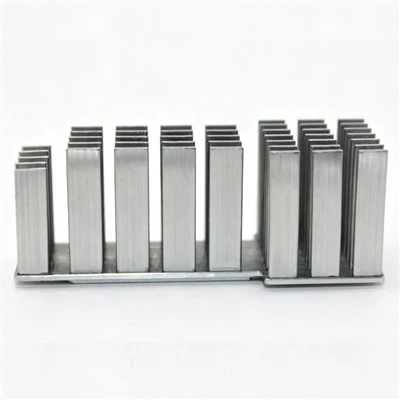
First, let’s make sure we’re on the same page with what heat dissipation rate actually means here. When a component (say, a CPU or a high-power LED) generates heat, that heat has to move through the heat sink and escape into the surrounding air. The dissipation rate is the amount of heat energy that moves from the component, through the base of the heat sink, and out into the environment per unit time—usually measured in watts (W). For an aluminum heat sink, that performance depends on three key factors: the metal’s thermal conductivity, the design of its fins (how much surface area there is to exchange heat), and how well air flows over those fins. Measuring it means controlling those variables so we can isolate and get an accurate, consistent number.
The first step in our process is setting up a standardized test chamber. We use a small, insulated box—usually made of foam or fiberglass with minimal thermal conductivity, so it doesn’t absorb or lose extra heat. Inside, we mount a standardized heat source: a resistive heater matched to the thermal load a heat sink would actually see, sized to fit the base of the heat sink exactly. We tape thermally conductive paste between the heater and the heat sink base to eliminate air gaps, which would mess up the heat transfer (even a small air gap can reduce performance by 10% or more, so we’re strict about that).
Once everything is mounted, we run the heater at a constant, known power input. That power is easy to calculate: we measure the voltage across the heater and the current flowing through it, multiply them together (Power = Voltage x Current) to get watts, which should equal the amount of heat the heater is generating. That’s our baseline. Now we let the system stabilize—wait until the temperature of the heat sink’s base stops rising, usually after 30 to 60 minutes depending on the size of the heat sink. Stabilization is non-negotiable here; if we measure too early, we get skewed numbers because the heat is still building up in the heat sink mass itself, not dissipating out.
Next, we take temperature readings. We place calibrated thermocouples at three key points: one on the heat sink’s base (right next to the heater), one in the air inside the chamber, and one at the midpoint of a fin on the heat sink. The base temperature tells us how well heat is moving from the heater into the heat sink. The air temperature is the ambient temperature of the test environment, which we keep at a consistent 25°C (standard room temperature) for every test to eliminate variables. The fin temperature helps us confirm that the heat is actually moving up through the fins and not just staying near the base.
Now we do the math to calculate heat dissipation rate. Wait, it’s actually simpler than it sounds, thanks to the stabilized temperature. At steady state, the heat the heater is putting out (our watts from voltage and current) should equal the heat the heat sink is dissipating into the air. But we also cross-check with a second method that’s common for aluminum heat sinks: the temperature difference method. The formula goes like this: Dissipation Rate (W) = Thermal Conductivity (W/m·K) x Surface Area (m²) x Temperature Difference (K). But wait, that’s for ideal conditions—so we adjust it for real-world use by factoring in convection (air flow) and radiation, two ways aluminum sheds heat. Radiation is the heat that emits straight from the heat sink’s surface, and convection is the heat that moves with air over the fins. For our tests, we account for both: in a natural convection test (no fan blowing), radiation makes up about 10-15% of the total dissipation for a standard aluminum heat sink, and convection makes up the rest. We confirm that by testing in a still-air chamber, so we don’t have to account for forced air variables unless the customer specifies a fan for their application.
Wait, but what if we’re testing a heat sink designed for a server that will have a 120mm fan blowing air at 100 CFM? We adjust the test setup for forced convection too. We mount a standardized fan (we use fans that meet industry standards for air flow and static pressure) at a fixed distance from the heat sink, set to run at a consistent speed, then repeat the same temperature and power measurements. That gives us the dissipation rate for forced air conditions, which is what most of our industrial and electronics customers care about. For example, a small 50mm x 50mm aluminum heat sink we make for power adapters will dissipate around 5W in still air, but jump to 12W with a small 5V fan blowing—data we get directly from these tests.
But here’s the thing: as aluminum heat sink suppliers, we don’t just run one test per design. We test every production batch, too, because even small differences in machining (like how smooth the base is, or how uniform the fin spacing is) can change performance. Last year, we had a first run of a heat sink for a medical device client that came out 2% lower in dissipation rate than our prototype test. We traced it to a 0.02mm gap in the base machining that meant the thermal paste didn’t spread evenly, so we adjusted our CNC tooling and haven’t seen that issue since. Testing every batch catches small, easy-to-miss errors before they reach a customer.
We also test for thermal resistance, which is another way to quantify performance that customers often ask for. Thermal resistance is the temperature difference between the heat source and ambient air per watt of heat, measured in °C/W. Lower thermal resistance means better dissipation. For our aluminum heat sinks, we aim for thermal resistance between 0.1 and 0.5 °C/W, depending on size and design. How does that tie back to dissipation rate? If you have a power source that runs at 30W, a thermal resistance of 0.3 °C/W means the heat source’s temperature will be 9°C above ambient—perfect for components that can’t run too hot. If the thermal resistance was higher, that temperature would jump to 15°C, which could cause overheating and early failure.
I’ve heard customers say “aluminum is just aluminum, so all heat sinks are the same,” but that’s not true. The way we measure and optimize these units makes a huge difference. We recently tested a competitor’s aluminum heat sink that looked identical on paper, but our test showed its dissipation rate was 15% lower. When we took it apart, the competitor had used thinner fins and a rougher base that didn’t transfer heat as well. That’s why our testing process isn’t just for internal quality—its data is what we use to tell customers exactly what they can expect from our product, no fine print.
Another check we do is testing at extreme temperatures, for customers using our aluminum heat sinks in outdoor or industrial applications. We put the test chamber in an environmental chamber that can hit -20°C or 60°C, run the same test, and measure how the dissipation rate changes. Aluminum is great here because its thermal conductivity stays consistent over a wide temperature range, unlike some plastics or lower-grade metals, so we can count on our data holding up. For a customer making LED lights for highway signs, that means our heat sink will work as well in -10°C winter temps as it does in 35°C summer heat.
At the end of the day, the goal of measuring heat dissipation rate for an aluminum heat sink isn’t just to get a number—it’s to build a product our customers can trust. When you buy an aluminum heat sink from us, you don’t have to guess if it will keep your component cool, because we’ve tested it in the conditions your application will face, and the data is on file. If you’re sourcing aluminum heat sinks for a project, whether it’s consumer electronics, industrial equipment, LED lighting, or automotive parts, we can work with you to design and test a unit that meets your exact dissipation requirements. We’re ready to walk through our test data, answer any questions you have about performance, and help you pick the right heat sink for your needs. If you’re ready to discuss your project, reach out to our team to get started.
Cooling Solution References:
- Incropera, F. P., & DeWitt, D. P. (2002). Introduction to Heat Transfer (4th ed.). John Wiley & Sons.
- American Society for Testing and Materials. (2018). Standard Test Method for Determining Thermal Resistance of Heat Sinks for Electronic Equipment (ASTM D5470-18). ASTM International.
- Bergman, T. L., Lavine, A. S., Incropera, F. P., & DeWitt, D. P. (2011). Fundamentals of Heat and Mass Transfer (7th ed.). John Wiley & Sons.
- Aluminum Association. (2020). Aluminum Heat Sink Design and Application Guidelines. The Aluminum Association.
- Zohuri, B. (2017). Thermal Design of Electronic Systems. Springer.
Dongguan Pioneer Thermal Technology Co., Ltd.
Dongguan Pioneer Thermal Technology Co., Ltd. is one of the most professional aluminum heat sink manufacturers and suppliers in China. With abundant experience, we warmly welcome you to buy customized aluminum heat sink made in China here from our factory. If you have any enquiry about quotation and free sample, please feel free to email us.
Address: Xiegang Village, Xiegang Town, Dongguan City, Guangdong Province, 523596, China
E-mail: vivian@ptheatsink.com
WebSite: https://www.coolingheatsink.com/
