If you’ve ever stood in the freeze dryer aisle (or scrolled through our product pages at 2 a.m., like I did when I first outgrew my tiny countertop model) wondering, “Wait—how big is big enough?” you’re not alone. As a freeze dryer supplier who’s fielded hundreds of panicked emails from people who bought the wrong size (think: a home baker who tried to freeze dry 50 jars of sourdough starter with a model that fits 1 gallon of total product, or a small farm vendor who spent $800 on a unit that takes 8 hours to process a single batch of berries—because they thought “bigger is always better”), let me break this down like I would with my cousin who still uses a 1998 Crock-Pot for canning. Size isn’t just about how much space the unit takes up on your counter—it’s about how much actual usable capacity you need, how often you’ll run batches, and whether you’ll need to scale later. There’s no one-size-fits-all here, and skipping this step is like buying a raincoat that fits a toddler when you’re 6’2”—it either doesn’t work or leaves you soaked. Freeze Dryer
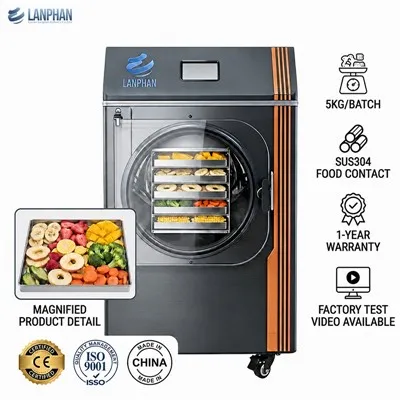
First, let’s get one myth out of the way: the biggest number listed on a freeze dryer spec sheet isn’t always the right one. When I first started selling freeze dryers, I’d read specs that said “1.5 cubic feet” and think, “That’s a huge capacity!” until a customer called me in tears saying their home freeze dryer couldn’t fit a single 5-pound batch of homemade pet treats. What they didn’t know was that most companies list “total chamber volume” — the full empty space inside the lid — not usable product capacity, which is what actually matters. Usable capacity is the space where you can place trays with food (or whatever you’re freeze drying), minus the space between trays required for air to circulate and the chamber walls. For example, a countertop freeze dryer with a listed “2 cubic foot total chamber” might only have 1.2 cubic feet of usable space, because that extra 0.8 cubic feet is just empty dead space you can’t fill with product. That’s the math you need to actually care about, not the flashy big number on the box.
So step one: calculate your monthly, or even weekly, freeze drying volume needs. This isn’t about guessing. Let’s take the two most common groups of customers I work with, because they’re the ones who consistently get this wrong: home users and small business owners. For home users, let’s say you want to freeze dry fruit for year-long smoothies, homemade jerky for hiking, and maybe occasional pet treat batches. A safe baseline here is a weekly volume of 1 to 3 gallons of pre-frozen product (yes, freeze drying requires you to freeze your food first—another mistake people make!). If you’re only doing small batches of berries once a month, that’s easy. But if you’re a family of four who wants to stock up on 2 gallons of sliced strawberries for the winter and another gallon of banana chips, you don’t want a countertop model that can only do 1.2 gallons per batch. You’ll be running it twice a week for four weeks, waiting days for each batch to finish, and burning out the unit faster because you’re overloading it repeatedly. For small business owners—say, a local bakery selling freeze-dried cake pops, a farm stand selling freeze-dried fruit snacks, or a home-based pet treat brand—you need to scale this up. Let’s say a pet treat maker wants to supply 5 local pet stores with 20 pounds of treats a month. Most freeze drying batches take 24 to 48 hours to complete, so if you want to process 20 pounds a month, you need a unit that can hold at least 5 to 8 pounds of finished product per batch, and ideally, one that can run two batches back-to-back without you having to re-freeze product between. That’s where sizing gets tricky: small business owners often underbuy because they’re scared of upfront costs, only to lose money because they’re paying for electricity (freeze dryers use more power than a fridge, but way less than an oven) to run twice as many batches as they need to.
Next, factor in your batch frequency and timeline. Let’s be real: no one wants to wait a full week to finish one batch of freeze-dried mangoes because their unit is too small. If you plan to run freeze drying as a consistent part of your routine—like, every weekend for meal prep, or twice a week for your small business—you need a unit that matches that frequency. I had a customer last year who ran a small wedding dessert business and bought a mid-sized freeze dryer, thinking she could process enough cake pops for 10 weddings a month. Turns out, each wedding needed 500 cake pops, and a mid-sized unit only holds 200 finished cake pops per batch. She was running three batches a week for four weeks, working 12-hour days, and ended up ordering a larger industrial model after two months because her original size was too slow for client deadlines. On the flip side, I’ve had customers who bought industrial-sized freeze dryers for home use—yes, that’s a thing—because they thought it would “be worth it.” They ended up using 1/10th the capacity, taking up half their garage, and wasting thousands of dollars on a unit that’s way too big for their needs. Industrial models are built for 24/7 runs for large production facilities, not for a family that does a few batches a month.
Then there’s the physical space you have. This is a surprisingly overlooked factor. A lot of people focus only on capacity, and forget that a big freeze dryer needs space around it for ventilation, access to plug it in, and room to take trays in and out. Freeze dryers generate some heat during the cycle, especially during the primary drying phase, so you can’t tuck it into a tight corner next to a fridge where air can’t circulate. I once sold a large batch freeze dryer to a customer who had a small utility closet; she tried to squeeze it in, closed the door, and the unit overheated mid-batch, ruining a $200 batch of organic blueberries. It took a week for it to cool down, and she had to move it into her kitchen, where it took up half her counter space for a month. Before you buy, measure not just the footprint of the unit itself (width, depth, height), but also the 12 to 18 inches of clearance needed on the back and sides for ventilation. If you have a small kitchen counter, a countertop model with 1.2 to 1.5 cubic feet of usable space is going to work better than a full-sized unit that won’t fit. If you have a garage or a dedicated production space, a larger unit with 4 to 6 cubic feet of usable space is doable.
Wait, what about scaling? If you’re a small business owner who’s planning to grow in the next year or two, don’t buy exactly what you need right now. Buy what you’ll need in 18 to 24 months. I see this all the time with new food brands: they start out making 10 pounds of product a month, then get a local store contract for 50 pounds a month, and suddenly their tiny freeze dryer is holding them back. When you’re choosing for growth, look for a unit that has expandable capacity—some of our mid-sized models let you add extra trays to increase usable space by 20 to 30% without buying a whole new unit. That way, you don’t have to replace your freeze dryer a year after buying it, saving you thousands in the long run. A home user might not need to scale, but if you plan to start a side hustle selling freeze-dried goods down the line, it’s worth spending a little extra on a unit that has room to grow, rather than settling for a tiny countertop model that’ll be obsolete by next year.
Let me give you a quick example to tie this all together, because numbers can get confusing. Let’s say you’re a home user who makes 2 gallons of pre-frozen fruit a month for smoothies, plus 1 gallon of homemade jerky for hiking snacks. Total monthly volume is 3 gallons. A countertop model with 1.5 cubic feet of usable space can hold roughly 1 gallon of pre-frozen fruit per batch (since food shrinks by about 1/3 when freeze dried—another key point I missed earlier! Raw fruit takes up more space, so finished dried fruit is smaller). So that model would take 3 batches to process your monthly needs, running one batch every other day. That’s manageable for a home user, no problem. But if you’re a small business owner who needs 15 gallons of pre-frozen fruit a month, that same countertop model would take 15 batches, running every day—wait 15 days just to process fruit, plus extra batches for jerky, and that’s way too slow. For that small business, you’d want a mid-sized unit with 4 cubic feet of usable space, which holds roughly 2.5 gallons per batch. That would take 6 batches for your monthly fruit, plus 1 for jerky, total 7 batches, running twice a week—way less wear and tear on the unit, less electricity cost, and you can fulfill orders faster.
Also, don’t forget to check the power requirements. Larger freeze dryers use more electricity, which means you need a dedicated 240-volt outlet, not just a standard 110-volt. If you have an old home or a small kitchen with only standard outlets, a full-sized industrial model won’t work, no matter how much capacity you need. That’s a common mistake: people look at a big unit, get excited about the capacity, and realize they can’t plug it in. So make sure your space can handle the power needs before you fall in love with a unit.
I’ve been selling freeze dryers for 7 years now, and the number one regret I hear from customers is not taking the time to size correctly. One customer, a teacher in Ohio, bought a tiny countertop model for her side hustle selling freeze-dried Halloween treats for kids. She thought it was perfect because it was small enough to store in her classroom closet, but she could only fit 100 treats per batch. By October, she was working nights and weekends, running 8 batches a week, and her unit burned out after 3 months. She had to buy a mid-sized unit, plus pay for repairs on the first one, costing her twice as much as if she’d bought the right size in the first place. Another customer, a retired nurse in Florida, bought a huge industrial unit because she loved freeze-drying her own coffee and thought it would be “fun.” She ended up selling it 6 months later because it took up too much space and used so much electricity that her monthly power bill went up by $150, and she only used 10% of the capacity.

At the end of the day, choosing the right size isn’t about picking the biggest or cheapest unit—it’s about matching the unit to your actual usage needs. If you take the time to calculate your weekly/monthly volume, factor in batch frequency, check your physical space and power requirements, and plan for growth if you need it, you’ll avoid the most common mistakes I see. If you’re still unsure, don’t guess. We’re here to help. We’ve worked with hundreds of home users, small business owners, and hobbyists to find the perfect size freeze dryer, no matter what your needs are. Whether you’re processing small batches for personal use or scaling for your brand, we can walk you through the specs, answer all your questions, and make sure you get a unit that works for you. Reach out to us to discuss your requirements, and we’ll help you find the right fit.
Horizontal Autoclave References:
- Freeze Drying Food: A Guide for Home Preservers, National Center for Home Food Preservation, University of Georgia Extension, 2021.
- Industrial Freeze Dryer Capacity Calculations for Small Food Businesses, USDA Agricultural Marketing Service, 2022.
- Electrical Requirements for Food Processing Equipment, Occupational Safety and Health Administration (OSHA), 2020.
- Freeze Drying Best Practices for Small Batch Producers, Small Business Administration (SBA), 2023.
Henan Lanphan Industry Co., Ltd.
We’re well-known as one of the leading freeze dryer suppliers in China, featured by quality products and good price. Please rest assured to wholesale durable freeze dryer for sale here from our factory. For more information, contact us now.
Address: Room 801, East Tower, Xiyuan Square, Zhongyuan District, Zhengzhou City, Henan Province
E-mail: lanphanindustry@lanphan.com
WebSite: https://www.lanphanindustry.com/
